
Why we're connecting second brains
Second brains and local-first AI have quietly gone mainstream, and they inherited one very old problem: every vault is an island. VulkanMM is our answer, a direct, end-to-end-encrypted link between two vaults, with no server in the middle.
A few years ago, keeping a second brain made you a hobbyist. Today it is close to normal. People run Obsidian and a pile of plain Markdown notes, and more and more of them point a local AI assistant at that pile so it can answer from what they actually know. On-device models made it practical; the habit did the rest. Personal knowledge, structured and searchable, is quietly becoming infrastructure.
That is genuinely good. It is also exactly where the trouble starts.
Every vault is an island
The knowledge you build lives in one place, on one machine, owned by one person. The moment two people want to share a slice of what they know, the tools fall away. You export a folder, zip it, email it, paste it into a chat, and watch the structure dissolve on the way. Links break. Context evaporates. The careful graph you spent months tending arrives as a flat dump in someone else's downloads folder.
AI makes the silo louder, not quieter. Your assistant is brilliant about your island and completely blind to everyone else's. Two people can each keep a rich, well-tended vault and still have no good way to let their assistants meet in the middle. The knowledge is there. The bridge is not.
A second brain that cannot reach another is just a very well-organised silo.
No server in the middle
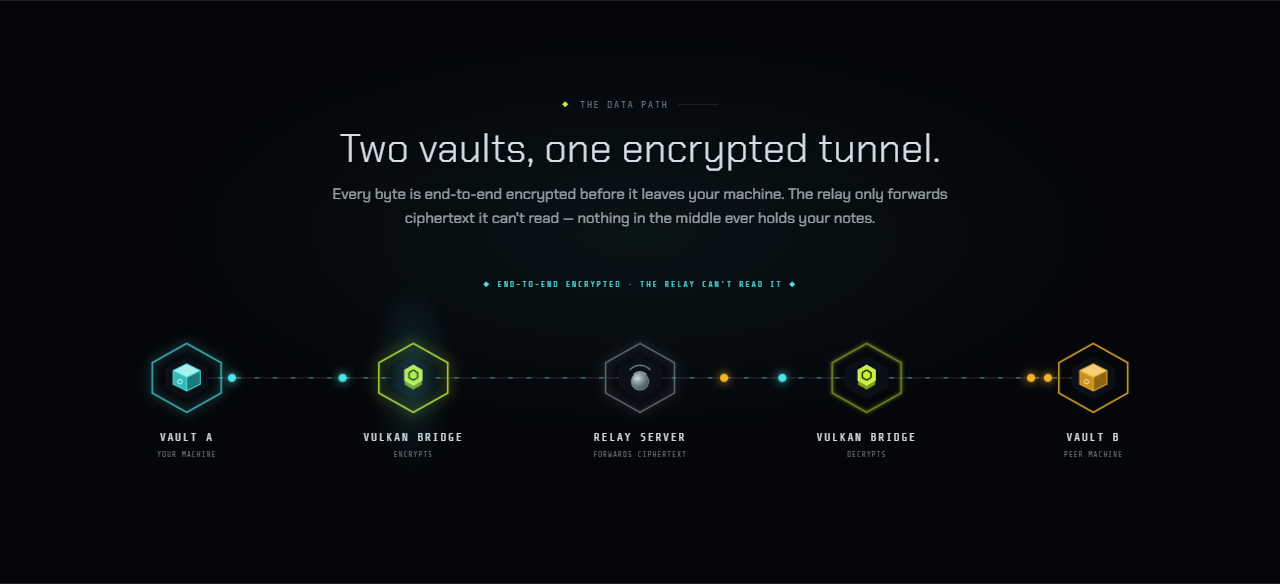
So we built the bridge. VulkanMM is a direct, end-to-end-encrypted link between two vaults, and the load-bearing word is direct. Every byte is encrypted on your machine before it leaves. A relay only forwards ciphertext it cannot read. Nothing in the middle ever holds your notes, because there is barely a middle at all: no cloud, no accounts, no VulkanMM server sitting on your knowledge waiting to be breached.
The transport is peer-to-peer over iroh, a QUIC layer that punches a connection straight between the two machines. A public relay only brokers the opening handshake, and if you would rather not touch the mesh, you can bring your own. The stream is keyed to your Ed25519 identity, which doubles as your node's address. It is written in Rust, small and memory-safe, and folder scope is enforced on the serving side, so an out-of-scope request is refused over the wire, not quietly filtered after the fact.
No cloud, no accounts, no VulkanMM server to breach. The relay only ever forwards ciphertext it cannot read, and your notes never leave your machine except over the direct, encrypted peer link.
Meet the bridge
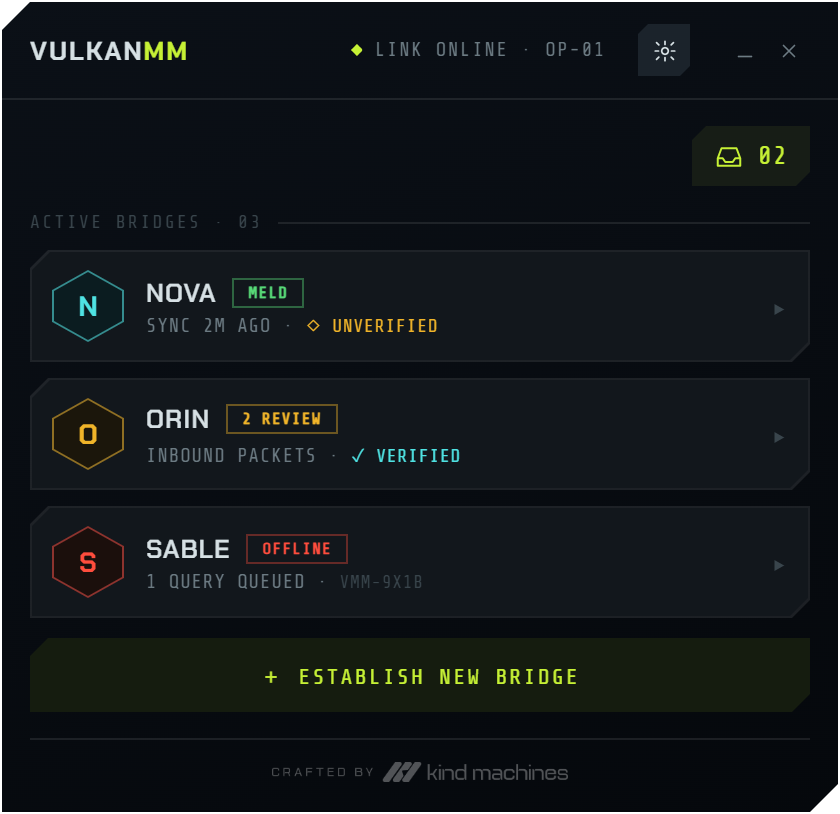
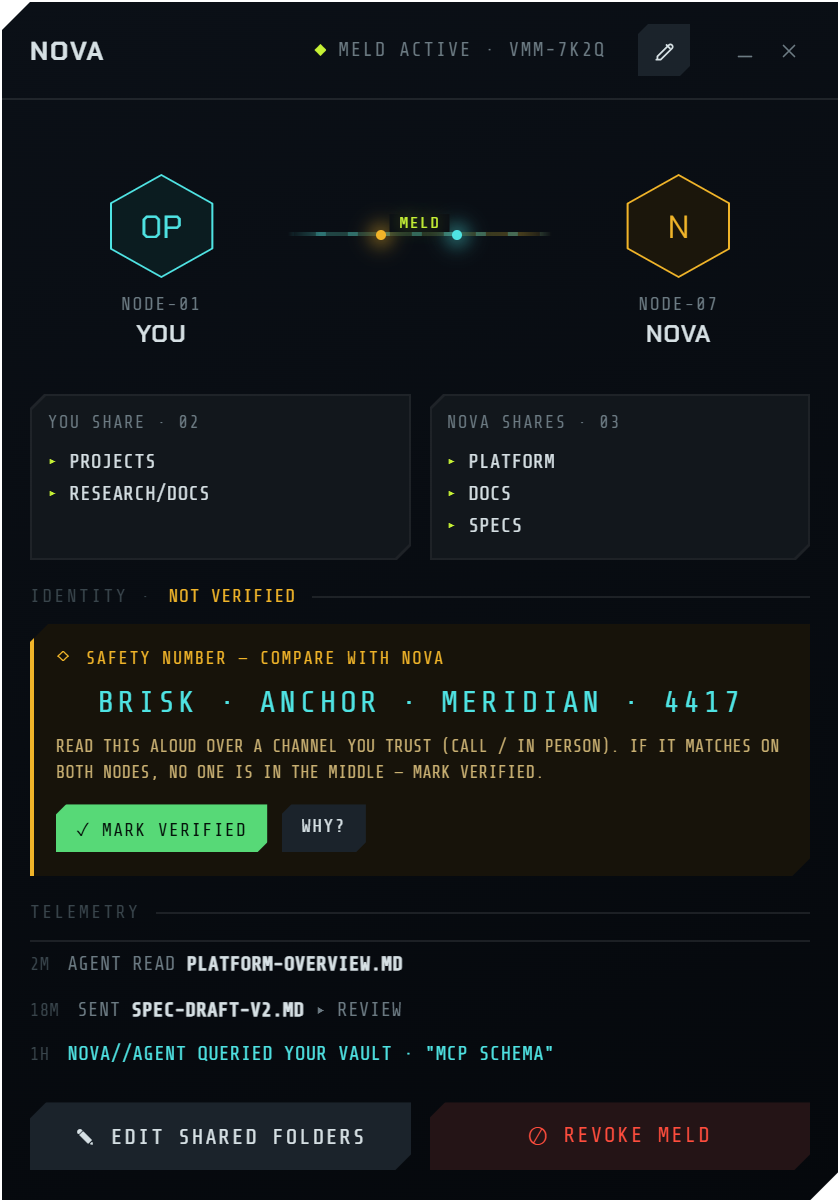
Open VulkanMM and you see your bridges, not a feed. Each one is a live link to another operator's vault, with its own state: online, syncing, offline, verified or not yet. A bridge is a relationship, and the app treats it like one rather than like a folder you dropped in a shared drive.
Your AI, across the bridge
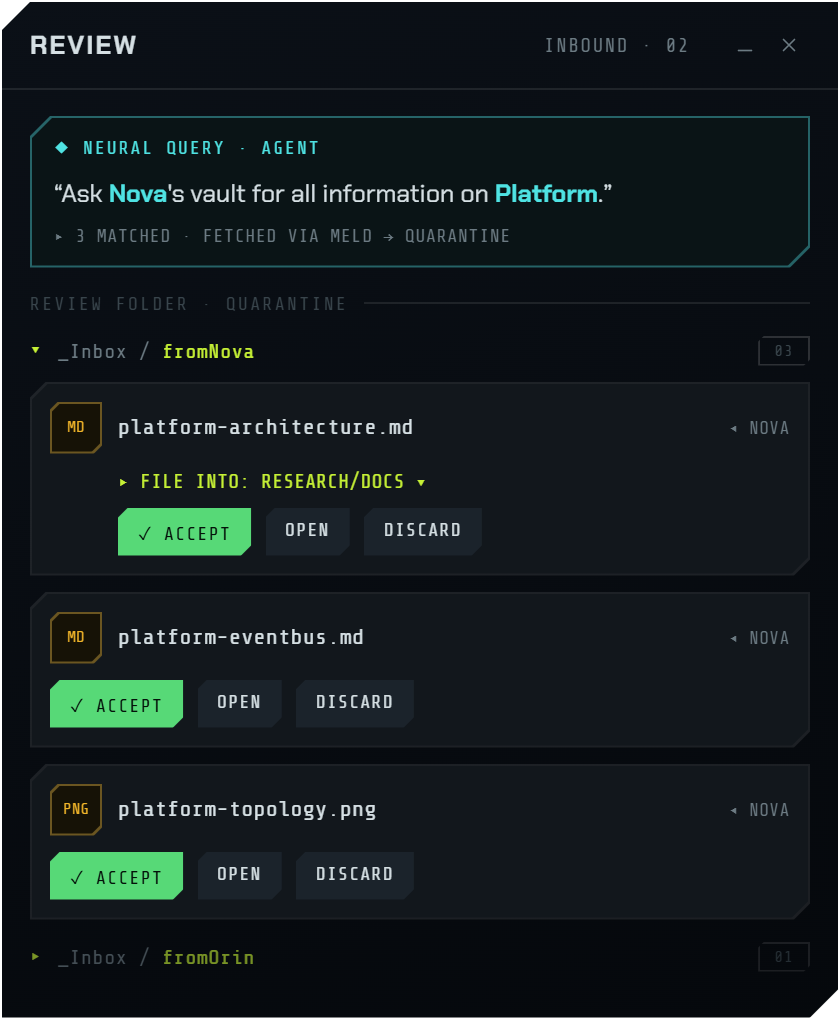
The point was never just moving files around. It is letting your assistant reach a peer's knowledge the same way it reaches yours. VulkanMM hosts a Model Context Protocol server on your own machine, bound to 127.0.0.1:7333. Point Claude, or any MCP client, at it and ask in plain language: "search Nova's vault for the platform spec." The read runs against Nova's live vault, over the encrypted link, read-only, with her scope and her approval policy applied on her side. Matches come back and land in a review folder, tagged with exactly where they came from.
You decide what crosses
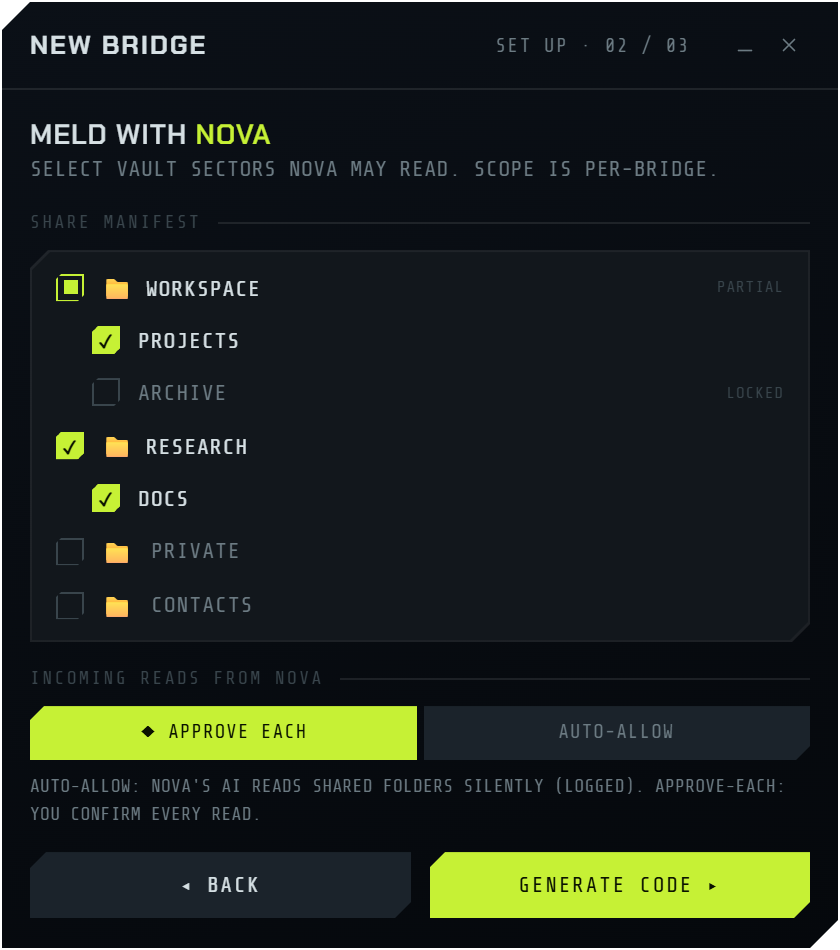
None of this is all-or-nothing. Access is scoped per bridge and reversible at any moment. A share manifest lets you pick exactly which folders a peer may read, nested and granular, down to a single subfolder, and it is different for every bridge. You can approve each read as it happens, or let a trusted bridge read silently. Either way, it is logged.
Inbound content is never trusted by default. A file a peer sends lands in a per-sender quarantine with full provenance, and it does not enter your vault until you say so. You review it, file it where it belongs, or discard it. Your vault only ever grows on your terms.
Trust you can watch
Every search and every read is visible to both operators, live. Trust here is not a line on a pricing page; it is a mutual audit trail you watch as it happens. Identities are pinned on first use and confirmed out of band with a short safety number you read aloud over a channel you already trust. If a peer's key ever changes, a reinstall, a new device, or something worse, reads pause until you re-verify.
Shipping now
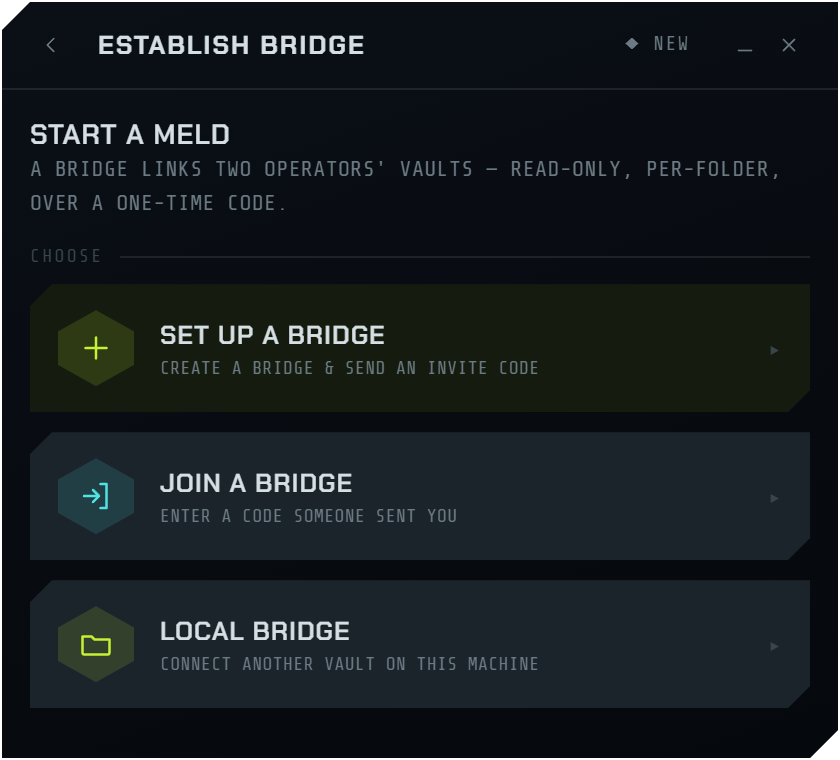
VulkanMM is early, and it is real. It is shipping for Windows today, with macOS close behind, built on iroh with end-to-end encryption by default rather than as an upsell. Setting up a bridge takes a one-time code and about a minute. It is version zero-point-something, and we are building it in the open and honestly: some of the harder pieces are still landing. But the core is here, and it works.
The second machine
Braidsheet was about making one person's thinking legible. VulkanMM is about letting two people's thinking meet, without a landlord in the middle taking a cut of the trust. Your vault stays yours. Collaboration stops meaning surrender. Two second brains, one encrypted tunnel, and nothing in between that can read a word of it. That is VulkanMM, and it is the second machine.